











Staff Picks
-

100 Rules for Living to 100
On the eve of his 100th birthday, national treasure Dick Van Dyke brings us this autobiographical collection of life advice, stories, and reflections on how he's maintained a zest for life.
Dick Van Dyke danced his way into our hearts with iconic roles in Mary Poppins, Chitty Chitty Bang Bang, and The Dick Van Dyke Show. Now, as he's about to turn 100 years old, Dick is still dancing and approaching life with the twinkle in his eye that we've come to know and love. In 100 Rules for Living to 100, he reveals his secrets for maintaining your joie de vivre and making the most out of the life you've been given.
Through stories of his pivotal childhood, moments on film sets, his expansive family, and finding love late in life, Dick reflects on both the joyful times and the challenges that shaped him. His indefatigable spirit and positive attitude will surely inspire readers to count the blessings in their own lives, persevere through the hard times, and appreciate the beauty and complexity of being human. -

The Charmed Library
With her signature blend of magical and heartfelt storytelling, USA TODAY bestselling author Jennifer Moorman returns with The Charmed Library, a love letter to libraries, favorite childhood stories, and readers who have fallen for fictional heroes.
Like many other public libraries, the one in Blue Sky Valley, North Carolina, is a haven for readers. But it's also unlike any other. In this library, fictional characters step off the page into real life. Assistant librarian Stella Parker has no idea. Still reeling from her father's death and--more recently--a breakup, she hasn't noticed. All she knows is she's stuck in a job she's overqualified for and stumped about what to do with her life.
Everything changes when she burns her beloved journal.
Words matter to Stella. For as long as she can remember, she's seen them. Words appear--in varying colors and fonts--rising from surfaces, bouncing over objects, and even wiggling out of people. Words give her insight into emotions and untold stories. But the words change for Stella after she burns her journal. Suddenly they're demanding, urgent--and painful.
Then Stella stumbles upon strange characters in the library after hours. One is an oddly familiar World War II soldier who introduces himself as Jack--Jack Mathis, the main character from her favorite book. A fictional hero and Stella's first crush. Standing in front of her in the flesh.
Jack tells Stella about the magic hidden in the library. Skeptical, Stella rashly invites a villain to visit, and chaos ensues. As she discovers the importance of protecting the library's secret and gets to know the real Jack, words continue to appear. What are they trying to tell her?
Much too quickly, Stella is faced with the reality that all stories must end, and magic comes at a price. The characters who visit the library can only stay for fourteen days. And Jack's time is almost up.
A cozy, Hallmark-esque rom-com, The Charmed Library invites readers to escape to a world where words come alive and book boyfriends leap off the page.
-

The Impossible Thing
How do you find something that doesn’t exist?
1926. On the cliffs of Yorkshire, men are lowered on ropes to steal the eggs of the sea birds who nest there. The most beautiful are sold for large sums. A small girl—penniless and neglected by her family—retrieves one such treasure. Its discovery will forever alter the course of her life.
A century later. In a remote cottage in Wales, Patrick Fort finds his friend, Nick, and his mother tied up and robbed. The only thing missing: a carved case containing an incredible scarlet egg. Doggedly attempting to retrieve it, Patrick and Nick discover the cruel world of egg trafficking, and soon find themselves on the trail of a priceless collection of eggs lost to history. Until now.
A taut, wonderfully imagined novel brimming with skullduggery at every turn, The Impossible Thing is a blazing testament to Belinda Bauer’s status as one of our greatest living crime writers.
-

The Viper
Andrew Fechmeier is a master at hiding. He'd better be--he's spent decades concealing a secret that could get him killed. So when he's diagnosed with a terminal disease, he heads for the local funeral home carrying the blue suit he eventually wants to be buried in. But what no one knows is that Fechmeier secretly tucked something inside, turning the suit into a final, untraceable hiding spot.
It's a perfect plan. Until Fetch is brutally murdered by a mysterious killer who will stop at nothing to find the priceless object hidden in the suit.
Wasting no time, the cunning but unconventional Roddy LaPointe opens an investigation into Fetch's murder, recruiting help from his friend, the brilliant "Zig" Zigarowski. But it doesn't take long for Zig to discover the real reason Roddy cares so much about this case: Fetch's death is tied to Roddy's mother, who was murdered decades earlier.
As the relentless killer closes in, Roddy's twin sister--the enigmatic and volatile Nola Brown--starts investigating for herself, uncovering a sinister plot that reveals their mother's dark history, the true identity of her killer, and the shocking secret behind her death.
Don't turn your back on The Viper.
-

The Book of Superstitions
Learn the compelling cultural histories behind some of the world’s supernatural beliefs with The Book of Superstitions.
Friday the 13th; rabbit feet; knocking on wood; walking under a ladder; the curse of the evil eye. We all have a superstition or two. Unveil the origins of some of the most universal and little known superstitions that have influenced cultures around the world for centuries. Including beliefs that gained a foothold in African and European folklore, notions from ancient Greece, legends of the British Isles, and beyond, this is a captivating read for people of all ages and backgrounds.
Inside you’ll find:
- Legends and cultural behaviors organized by region, so you can discover how cultural identity has impacted these beliefs over the years
- Beautiful illustrations of these fascinating concepts
- An analysis of how superstitions vary from country to country
Discover why superstitions have bewitched us for centuries with The Book of Superstitions. Fingers crossed you’ll love this book! -

Heart the Lover
You knew I'd write a book about you someday.
Our narrator understands good love stories--their secrets and subtext, their highs and free falls. But her greatest love story, the one she lived, never followed the simple rules.
In the fall of her senior year of college, she meets two star students from her 17th-Century Lit class: Sam and Yash. Best friends living off campus in the elegant house of a professor on sabbatical, the boys invite her into their intoxicating world of academic fervor, rapid-fire banter and raucous card games. They nickname her Jordan, and she quickly discovers the pleasures of friendship, love and her own intellectual ambition. But youthful passion is unpredictable, and soon she finds herself at the center of a charged and intricate triangle. As graduation comes and goes, choices made will alter these three lives forever.
Decades later, the vulnerable days of Jordan's youth seem comfortably behind her. But when a surprise visit and unexpected news bring the past crashing into the present, she returns to a world she left behind and must confront the decisions and deceptions of her younger self.
Written with the superb wit and emotional sensitivity fans and critics of Lily King have come to adore, Heart the Lover is a deeply moving love story that celebrates literature, forgiveness, and the transformative bonds that shape our lives. Wise, unforgettable, and with a delightful connective thread to Writers & Lovers, this is King at her very best, affirming her as a masterful chronicler of the human experience and one of the finest novelists at work today.
-

My Beloved
When Father Tim’s wife, Cynthia, asks what he wants for Christmas, he pens the answer in a love letter that bares his most private feelings. Then the letter goes missing and circulates among his astonished neighbors. So much for private.
Can a letter change a life? Ask Helene, the piano teacher who has avoided her feelings for a lifetime. Ask Hope, the village bookseller who desperately needs something that’s impossibly out of reach. Or, if you’d like to know how a brush with death can be the portal to a happy marriage, Cynthia will tell you all about it.
In My Beloved, Harley gets an important letter of his own; a broken heart teaches the Old Mayor, Esther Cunningham, a lesson long in coming; and thanks to Lace and Dooley, readers get what they’ve been waiting for: Sadie.
Poignant, hilarious, and life-affirming, My Beloved sets a generous table for millions of readers who love these characters like family. With Karon’s signature humanity shining through on every page, this is a season of life in Mitford you won’t want to miss. -

And the Crowd Went Wild
#1 New York Times bestselling author Susan Elizabeth Phillips is back with the latest novel in her beloved Chicago Stars series, featuring a romance between a star quarterback and one of the country's most beautiful--and misunderstood--actresses.
After a mortifying--and very public--humiliation, Dancy Flynn is desperate to find sanctuary far from the crowd. But where can a washed-up sex symbol hide How about making an unannounced appearance at the secluded lake house of the sweet, sensitive high school boyfriend she hasn't seen in almost twenty years
But Chicago Stars quarterback Clint Garrett is no longer the kid Dancy remembers. Now he's a gridiron superhero, still holding a massive grudge against her for breaking his teenage heart. With no room in his life for either complexity or distractions, he banishes Dancy to a refurbished old railroad caboose tucked away in the woods...and out of his sight.
Except Dancy's not good at staying invisible. Her efforts to rebuild her career clash with Clint's desperation to regain his focus, all made more challenging by a rescue dog, a local woman in trouble, a meddling mother, an ex with an agenda...and the sizzle of rekindled emotions.
As Dancy attempts to get her life on track and Clint tries to get his groove back, can these two one-time lovers navigate their rocky pasts and complicated present to find themselves...and each other
Tropes include:
- second-chance romance
- enemies to lovers
- forced proximity
- childhood sweethearts
-

Wild Dark Shore
A family on a remote island. A mysterious woman washed ashore. A rising storm on the horizon.
Dominic Salt and his three children are caretakers of Shearwater, a tiny island not far from Antarctica. Home to the world’s largest seed bank, Shearwater was once full of researchers, but with sea levels rising, the Salts are now its final inhabitants. Until, during the worst storm the island has ever seen, a woman mysteriously washes ashore.
Isolation has taken its toll on the Salts, but as they nurse the woman, Rowan, back to strength, it begins to feel like she might just be what they need. Rowan, long accustomed to protecting herself, starts imagining a future where she could belong to someone again.
But Rowan isn’t telling the whole truth about why she set out for Shearwater. And when she discovers sabotaged radios and a freshly dug grave, she realizes Dominic is keeping his own secrets. As the storms on Shearwater gather force, they all must decide if they can trust each other enough to protect the precious seeds in their care before it’s too late—and if they can finally put the tragedies of the past behind them to create something new, together.
A novel of breathtaking twists, dizzying beauty, and ferocious love, Wild Dark Shore is about the impossible choices we make to protect the people we love, even as the world around us disappears. -

Llama Llama Loves to Read
Anna Dewdney's Bestselling Llama Llama series continues with Llama learning to read!
Llama Llama learns at school.
Counting, writing, reading, rules.
Friends and school -- there's nothing better.
Llama learning all the letters!
Anna Dewdney's beloved Llama Llama is growing up and learning to read! Throughout the school day, the teacher helps Llama Llama and the other children practice their letters, shows word cards, reads stories, and brings them to the library where they can all choose a favorite book. By the end of the day, Llama Llama is recognizing words and can't wait to show Mama Llama that he's becoming a reader! -

The Kissing Hand
School is starting in the forest, but Chester Raccoon does not want to go. To help ease Chester's fears, Mrs. Raccoon shares a family secret called the Kissing Hand to give him the reassurance of her love any time his world feels a little scary. Since its first publication in 1993, this heartwarming book has become a children's classic that has touched the lives of millions of children and their parents, especially at times of separation, whether starting school, entering daycare, or going to camp. It is widely used by kindergarten teachers on the first day of school. Stickers at the back will help children and their parents keep their Kissing Hand alive.
-

Guess How Much I Love You
"Guess how much I love you," says Little Nutbrown Hare. Little Nutbrown Hare shows his daddy how much he loves him: as wide as he can reach and as far as he can hop. But Big Nutbrown Hare, who can reach farther and hop higher, loves him back just as much. Well then Little Nutbrown Hare loves him right up to the moon, but that's just halfway to Big Nutbrown Hare's love for him.
Blog Entries
Digital Memory Lab Available at the Owosso Library
Don't let your family history be lost because technology has changed. We can help you preserve your special family documents in a digital format that can easily be stored and shared. Contact the Owosso Library for more information.
Upcoming Events
The public is welcome to attend the Shiawassee District Library Board meeting.
Storytime
Come for stories, music, crafts and more! Aimed toward preschool aged children, but children of all ages are welcome. Dress for a mess!
Disclaimer(s)
Accessibility
The library makes every effort to ensure our programs can be enjoyed by all. If you have any concerns about accessibility or need to request specific accommodations, please contact the library.
Accompanying Adults
This program is designed for children and accompanying adults. Please plan to attend and be engaged with your child for this program. Drop offs will not be permitted.
Registration required!
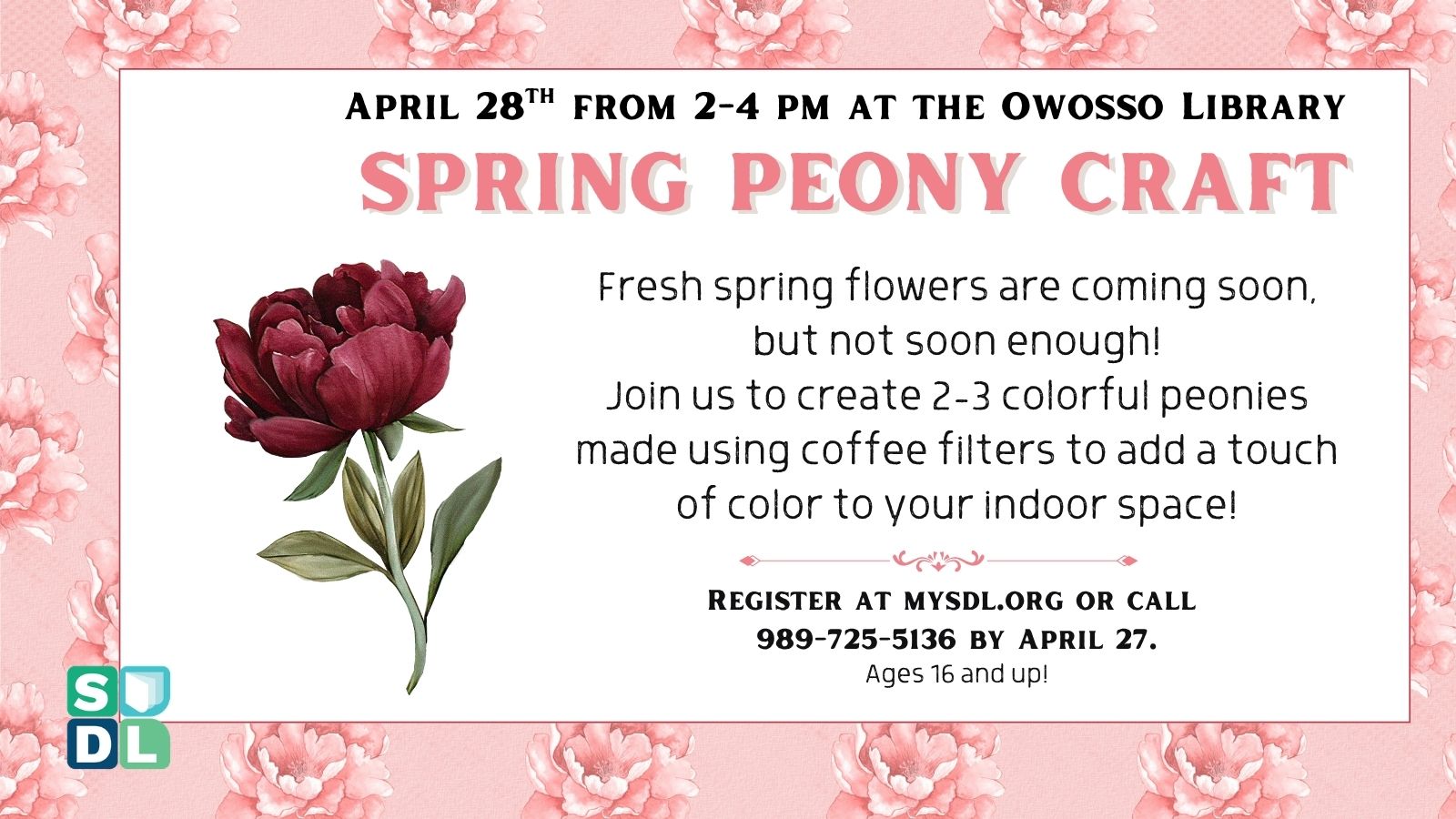
Fresh spring flowers are coming soon, but not soon enough!
Storytime
Come for stories, music, crafts and more! Aimed toward preschool aged children, but children of all ages are welcome. Dress for a mess!
Disclaimer(s)
Accessibility
The library makes every effort to ensure our programs can be enjoyed by all. If you have any concerns about accessibility or need to request specific accommodations, please contact the library.
Accompanying Adults
This program is designed for children and accompanying adults. Please plan to attend and be engaged with your child for this program. Drop offs will not be permitted.
📚✨ Join Us for Play & Storytime at the Library! ✨📚
Storytime
Come for stories, music, crafts and more! Aimed toward preschool aged children, but children of all ages are welcome. Dress for a mess!
Disclaimer(s)
Accessibility
The library makes every effort to ensure our programs can be enjoyed by all. If you have any concerns about accessibility or need to request specific accommodations, please contact the library.
Accompanying Adults
This program is designed for children and accompanying adults. Please plan to attend and be engaged with your child for this program. Drop offs will not be permitted.
Storytime
Come for stories, music, crafts and more! Aimed toward preschool aged children, but children of all ages are welcome. Dress for a mess!
Disclaimer(s)
Accessibility
The library makes every effort to ensure our programs can be enjoyed by all. If you have any concerns about accessibility or need to request specific accommodations, please contact the library.
Accompanying Adults
This program is designed for children and accompanying adults. Please plan to attend and be engaged with your child for this program. Drop offs will not be permitted.
Storytime
Come for stories, music, crafts and more! Aimed toward preschool aged children, but children of all ages are welcome. Dress for a mess!
Disclaimer(s)
Accessibility
The library makes every effort to ensure our programs can be enjoyed by all. If you have any concerns about accessibility or need to request specific accommodations, please contact the library.
Accompanying Adults
This program is designed for children and accompanying adults. Please plan to attend and be engaged with your child for this program. Drop offs will not be permitted.
America 250 Reading Recommendations
-

The Greatest Sentence Ever Written
To celebrate America’s 250th anniversary, Walter Isaacson takes readers on a fascinating deep dive into the creation of one of history’s most powerful sentences: “We hold these truths to be self-evident, that all men are created equal, that they are endowed by their Creator with certain unalienable Rights, that among these are Life, Liberty, and the pursuit of Happiness.”
Drafted by Thomas Jefferson and edited by Benjamin Franklin and John Adams, this line lays the foundation for the American Dream and defines the common ground we share as a nation.
Isaacson unpacks its genius, word by word, illuminating the then-radical concepts behind it. Readers will gain a fresh appreciation for how it was drafted to inspire unity, equality, and the enduring promise of America. With clarity and insight, he reveals not just the power of these words but describes how, in these polarized times, we can use them to restore an appreciation for our common values. -

These Truths
In the most ambitious one-volume American history in decades, award-winning historian and New Yorker writer Jill Lepore offers a magisterial account of the origins and rise of a divided nation, an urgently needed reckoning with the beauty and tragedy of American history.
Written in elegiac prose, Lepore’s groundbreaking investigation places truth itself—a devotion to facts, proof, and evidence—at the center of the nation’s history. The American experiment rests on three ideas—"these truths," Jefferson called them—political equality, natural rights, and the sovereignty of the people. And it rests, too, on a fearless dedication to inquiry, Lepore argues, because self-government depends on it. But has the nation, and democracy itself, delivered on that promise?
These Truths tells this uniquely American story, beginning in 1492, asking whether the course of events over more than five centuries has proven the nation’s truths, or belied them. To answer that question, Lepore traces the intertwined histories of American politics, law, journalism, and technology, from the colonial town meeting to the nineteenth-century party machine, from talk radio to twenty-first-century Internet polls, from Magna Carta to the Patriot Act, from the printing press to Facebook News.
Along the way, Lepore’s sovereign chronicle is filled with arresting sketches of both well-known and lesser-known Americans, from a parade of presidents and a rogues’ gallery of political mischief makers to the intrepid leaders of protest movements, including Frederick Douglass, the famed abolitionist orator; William Jennings Bryan, the three-time presidential candidate and ultimately tragic populist; Pauli Murray, the visionary civil rights strategist; and Phyllis Schlafly, the uncredited architect of modern conservatism.
Americans are descended from slaves and slave owners, from conquerors and the conquered, from immigrants and from people who have fought to end immigration. "A nation born in contradiction will fight forever over the meaning of its history," Lepore writes, but engaging in that struggle by studying the past is part of the work of citizenship. "The past is an inheritance, a gift and a burden," These Truths observes. "It can’t be shirked. There’s nothing for it but to get to know it."
-

The Revolutionary
This revelatory biography from a Pulitzer Prize-winning author explores the story of the most essential Founding Father--the one who stood behind the change that sparked the American Revolution.
Thomas Jefferson asserted that if there was any leader of the Revolution, "Samuel Adams was the man." With high-minded ideals and bare-knuckle tactics, Adams led what could be called the greatest campaign of civil resistance in American history.
Stacy Schiff returns Adams to his seat of glory, introducing us to the shrewd and eloquent man who supplied the moral backbone of the American Revolution. A singular figure at a singular moment, Adams amplified the Boston Massacre. He helped to mastermind the Boston Tea Party. He employed every tool available to rally a town, a colony, and eventually a band of colonies behind him, creating the cause that created a country.
For his efforts he became the most wanted man in America--when Paul Revere rode to Lexington in 1775, it was to warn Samuel Adams that he was about to be arrested for treason. In The Revolutionary: Samuel Adams, Schiff brings her masterful skills to Adams' improbable life, illuminating his transformation from aimless son of a well-off family to tireless, beguiling radical who mobilized the colonies.
Arresting, original, and deliriously dramatic, this is a long-overdue chapter in the history of our nation.
-

Chains
If an entire nation could seek its freedom, why not a girl?
As the Revolutionary War begins, thirteen-year-old Isabel wages her own fight...for freedom. Promised freedom upon the death of their owner, she and her sister, Ruth, in a cruel twist of fate become the property of a malicious New York City couple, the Locktons, who have no sympathy for the American Revolution and even less for Ruth and Isabel. When Isabel meets Curzon, a slave with ties to the Patriots, he encourages her to spy on her owners, who know details of British plans for invasion. She is reluctant at first, but when the unthinkable happens to Ruth, Isabel realizes her loyalty is available to the bidder who can provide her with freedom.
From acclaimed author Laurie Halse Anderson comes this compelling, impeccably researched novel that shows the lengths we can go to cast off our chains, both physical and spiritual. -

Common Sense (with a Biographical Introduction by John M. Robertson)
First published on January 10, 1776, Thomas Paine's "Common Sense" was one the most influential and best-selling works from the colonial period. It has been suggested that it may have been the single biggest factor in inspiring the people of the Thirteen Colonies to declare and fight for their independence from Great Britain beginning in the summer of 1776. One of the central political arguments amongst the colonists of the pre-revolutionary period was whether or not they should indeed seek independence and freedom from British rule. The consequences of speaking out against the British Empire were potentially lethal, and as such, the decision of when, where, and how to do so had to be considered with great care. Given its treasonable content and so as not to distract from the central message of the work, Thomas Paine chose to publish the work anonymously. "Common Sense" provided a straightforward argument in clear, simple language, to the American people as to why they should seek independence, and its importance to the shaping of American history cannot be overstated. This edition is printed on premium acid-free paper and includes a biographical introduction by John M. Robertson.
-

Ladies of Liberty
In Founding Mothers, Cokie Roberts paid homage to the heroic women whose patriotism and sacrifice helped create a new nation. Now the number one New York Times bestselling author and renowned political commentator—praised in USA Today as a "custodian of time-honored values"—continues the story of early America's influential women with Ladies of Liberty. In her "delightfully intimate and confiding" style (Publishers Weekly), Roberts presents a colorful blend of biographical portraits and behind-the-scenes vignettes chronicling women's public roles and private responsibilities.
Recounted with the insight and humor of an expert storyteller and drawing on personal correspondence, private journals, and other primary sources—many of them previously unpublished—Roberts brings to life the extraordinary accomplishments of women who laid the groundwork for a better society. Almost every quotation here is written by a woman, to a woman, or about a woman. From first ladies to freethinkers, educators to explorers, this exceptional group includes Abigail Adams, Margaret Bayard Smith, Martha Jefferson, Dolley Madison, Elizabeth Monroe, Louisa Catherine Adams, Eliza Hamilton, Theodosia Burr, Rebecca Gratz, Louisa Livingston, Rosalie Calvert, Sacajawea, and others. In a much-needed addition to the shelves of Founding Father literature, Roberts sheds new light on the generation of heroines, reformers, and visionaries who helped shape our nation, giving these ladies of liberty the recognition they so greatly deserve.
-

Benjamin Franklin
In this authoritative and engrossing full-scale biography, Walter Isaacson, bestselling author of Einstein and Steve Jobs, shows how the most fascinating of America's founders helped define our national character.
Benjamin Franklin is the founding father who winks at us, the one who seems made of flesh rather than marble. In a sweeping narrative that follows Franklin’s life from Boston to Philadelphia to London and Paris and back, Walter Isaacson chronicles the adventures of the runaway apprentice who became, over the course of his eighty-four-year life, America’s best writer, inventor, media baron, scientist, diplomat, and business strategist, as well as one of its most practical and ingenious political leaders. He explores the wit behind Poor Richard’s Almanac and the wisdom behind the Declaration of Independence, the new nation’s alliance with France, the treaty that ended the Revolution, and the compromises that created a near-perfect Constitution.
In this colorful and intimate narrative, Isaacson provides the full sweep of Franklin’s amazing life, showing how he helped to forge the American national identity and why he has a particular resonance in the twenty-first century.